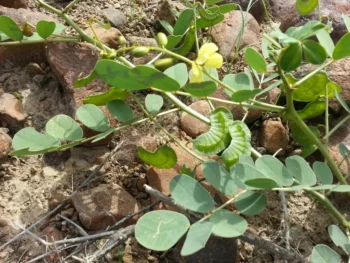
Port Royal Senna: A Drought-Tolerant Beauty with Golden Blooms
If you’re looking for a plant that laughs in the face of drought while serving up cheerful yellow flowers, Port Royal senna (Senna italica) might just catch your eye. This perennial forb brings a touch of Mediterranean charm to gardens, though it comes with some considerations worth knowing about.
What Exactly is Port Royal Senna?
Port Royal senna is a non-native perennial that originally hails from North Africa and parts of the Middle East. You might also see it listed under its former scientific names like Cassia obovata or Senna obovata – botanists do love to shuffle names around! As a forb, it’s essentially an herbaceous plant without woody stems, growing fresh from the ground each season in its perennial fashion.
Where Does It Grow?
In the United States, Port Royal senna has established itself in Maryland and the U.S. Virgin Islands, where it reproduces on its own in the wild. While it’s considered non-native, it hasn’t been flagged as invasive or noxious in these areas.
- Species observed
- No observations
What Does It Look Like?
This plant puts on quite a show with its bright yellow flowers arranged in attractive clusters. The compound leaves have a lovely silvery-green hue that provides nice contrast in the garden. The overall growth habit is upright and branching, giving it a somewhat shrub-like appearance despite being an herbaceous perennial.
Garden Role and Design Uses
Port Royal senna works wonderfully in several garden scenarios:
- Desert and xeriscape gardens where water conservation is key
- Mediterranean-style landscapes
- Container gardens for moveable color
- Drought-tolerant borders and beds
The plant serves as both an ornamental specimen and a pollinator magnet, with bees particularly drawn to those sunny yellow blooms.
Growing Conditions and Care
Here’s where Port Royal senna really shines – it’s remarkably low-maintenance once you get it settled:
- Sunlight: Full sun is best for maximum flowering
- Soil: Well-draining soil is crucial; sandy or rocky soils are actually preferred
- Water: Drought tolerant once established, requiring minimal supplemental watering
- Climate: Hardy in USDA zones 9-11, though can be grown as an annual in cooler areas
Planting and Care Tips
Getting started with Port Royal senna is refreshingly straightforward:
- Plant after the last frost date in your area
- Space plants adequately to allow for air circulation
- Water regularly during establishment, then back off significantly
- Occasional pruning helps maintain a tidy shape and may encourage more blooms
- In colder zones, treat as an annual or grow in containers to bring indoors
Should You Plant It?
Port Royal senna can be a delightful addition to the right garden, especially if you’re dealing with challenging conditions like poor soil or limited water. However, since it’s not native to most of North America, you might want to consider native alternatives that provide similar benefits to local ecosystems.
Some native alternatives to consider include wild senna (Senna hebecarpa) for eastern regions, or desert senna (Senna covesii) for southwestern gardens. These native options will provide similar drought tolerance and yellow flowers while supporting local wildlife more effectively.
If you do choose to grow Port Royal senna, you’ll be rewarded with a plant that’s both beautiful and incredibly self-sufficient – just the kind of gardening win we all appreciate!