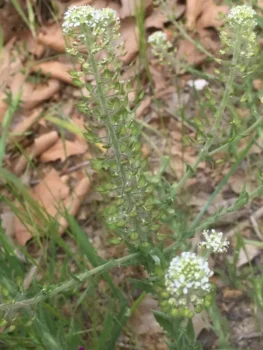
Purpleanther Field Pepperweed: A Non-Native Annual You’ll Want to Know About
If you’ve ever wondered about those small, white-flowered plants popping up along roadsides and in disturbed areas, you might be looking at purpleanther field pepperweed (Lepidium heterophyllum). While this little annual herb might seem innocuous enough, there’s more to this story than meets the eye.
What Exactly Is Purpleanther Field Pepperweed?
Purpleanther field pepperweed, also known scientifically as Lepidium heterophyllum (and sometimes by its synonym Lepidium smithii), is a non-native annual forb that has made itself quite at home in North America. As a forb, it’s essentially an herbaceous plant without woody stems – think of it as your typical weedy annual that completes its entire life cycle in one growing season.
This little plant has established itself as a persistent presence in both Canada and the lower 48 states, reproducing spontaneously without any help from us humans. In other words, once it arrives, it tends to stick around.
Where You’ll Find It
Currently, purpleanther field pepperweed has been documented in several states and provinces across North America, including British Columbia, California, Massachusetts, New Jersey, New York, Oregon, Pennsylvania, and Washington. It originally hails from Europe and western Asia, making it a long-distance traveler that has adapted well to North American conditions.
- Species observed
- No observations
Should You Plant It in Your Garden?
Here’s the thing about purpleanther field pepperweed – while it’s not officially listed as invasive in most areas, it’s also not something you’d typically want to invite into your carefully planned garden space. This plant is more of an opportunist, thriving in disturbed soils and areas where other plants struggle.
The aesthetic appeal is, frankly, quite limited. You’re looking at small white flowers arranged in clusters, and while they might attract a few small insects, they’re not going to be the showstopper in your pollinator garden. The overall appearance is more roadside volunteer than garden feature.
Better Native Alternatives
Instead of planting purpleanther field pepperweed, consider these native alternatives that offer similar growing habits but with better ecological benefits:
- Native pepperweeds or pepperworts (other Lepidium species native to your region)
- Wild mustards native to your area
- Native annual wildflowers suited to disturbed soils in your region
These natives will provide better wildlife habitat, support local ecosystems, and often offer more attractive flowers and foliage.
If It Shows Up Anyway
Given that purpleanther field pepperweed reproduces readily on its own, don’t be surprised if it appears in your garden without an invitation. As an annual, it completes its life cycle in one year, so preventing seed production is key to managing unwanted populations.
The plant tends to favor disturbed soils and areas with minimal competition, so maintaining healthy, established plantings of desirable species is often the best long-term management strategy.
The Bottom Line
While purpleanther field pepperweed isn’t necessarily harmful, it’s not adding much value to your garden either. This non-native annual is better appreciated as an example of plant adaptability rather than as a garden addition. Focus your energy on native species that will provide better ecological benefits and more reliable beauty for your landscape.
Remember, every plant in your garden is an opportunity to support local wildlife and ecosystems – so why not choose plants that truly belong in your corner of the world?