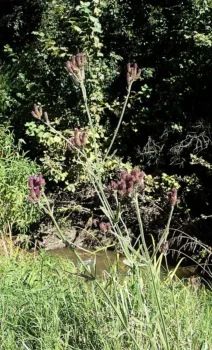
Non-native Plants

Purpletop Vervain

Verbena incompta

USDA symbol: VEIN9

biennial subshrub

Canada: non-native, naturalized
Hawaii: non-native, naturalized
Lower 48 states: non-native, naturalized
Puerto Rico: non-native, naturalized

Meet purpletop vervain (Verbena incompta), a charming plant that brings an airy, naturalistic feel to gardens across much of North America. With its delicate purple flower clusters dancing atop slender stems, this South American native has found a comfortable home in landscapes from coast to coast. Purpletop vervain is a ...

Purpletop Vervain: A Delicate Beauty for Your Garden

Meet purpletop vervain (Verbena incompta), a charming plant that brings an airy, naturalistic feel to gardens across much of North America. With its delicate purple flower clusters dancing atop slender stems, this South American native has found a comfortable home in landscapes from coast to coast.

What Exactly Is Purpletop Vervain?

Purpletop vervain is a non-woody flowering plant that can behave as an annual, biennial, or perennial depending on your climate and growing conditions. Originally from South America, this adaptable species has established itself across a wide range of North American regions, from the sunny Southwest to the humid Southeast.

You might also see this plant listed under its synonyms Verbena bonariensis in older gardening references, though botanists have since clarified the proper identification.

Where Does It Grow?

This versatile plant has spread far from its South American origins and now grows in an impressive list of locations including Alabama, Arizona, Arkansas, California, Florida, Georgia, Hawaii, Illinois, Louisiana, Massachusetts, Mississippi, New Jersey, New York, North Carolina, Oklahoma, Oregon, South Carolina, Tennessee, Texas, Virginia, and Puerto Rico. It’s even made its way into parts of Canada, specifically Ontario and Quebec.

  • Species observed
  • No observations

Should You Plant Purpletop Vervain?

The answer depends on what you’re looking for in your garden. Here are some reasons you might want to consider it:

  • Creates a soft, naturalistic appearance in informal garden settings
  • Attracts butterflies, bees, and other beneficial pollinators
  • Thrives in well-drained soils and tolerates drought once established
  • Self-seeds readily, providing ongoing garden interest
  • Works well in cottage gardens, meadow plantings, and pollinator gardens

However, since purpletop vervain isn’t native to North America, you might want to consider native alternatives that provide similar benefits while supporting local ecosystems. Native vervain species like blue vervain (Verbena hastata) or Brazilian vervain alternatives native to your region could be excellent substitutes.

Growing Conditions and Care

Purpletop vervain is refreshingly low-maintenance once you understand its preferences:

  • Sunlight: Full sun for best flowering
  • Soil: Well-drained soil; adaptable to various soil types
  • Water: Drought tolerant once established; avoid overwatering
  • Hardiness: Zones 7-10 (grows as annual in colder areas)

According to wetland indicators, this plant typically prefers non-wetland conditions but can occasionally tolerate some moisture, making it quite adaptable to different garden situations.

Planting and Care Tips

Getting started with purpletop vervain is straightforward:

  • Plant in spring after the last frost date
  • Space plants adequately as they can self-seed and spread
  • Deadhead spent flowers if you want to prevent excessive self-seeding
  • Allow some flowers to go to seed if you want natural reseeding
  • Minimal fertilization needed; too much can reduce flowering
  • Cut back in late fall or early spring in perennial zones

The Bottom Line

Purpletop vervain offers gardeners an easy-care option for adding delicate purple blooms and pollinator appeal to naturalistic landscapes. While it’s not native to North America, it’s not considered invasive either, making it a neutral choice for gardeners who appreciate its aesthetic qualities. Just remember to consider native alternatives first – your local ecosystem will thank you, and you’ll likely find equally beautiful options that are perfectly adapted to your specific region.

Whether you choose purpletop vervain or a native alternative, you’ll be adding valuable pollinator habitat and natural beauty to your garden space.

Verbena incompta is also known as...

Often we refer to plants by their common names. When shopping for plants the scientific name is the best way to positively identify the plant species you desire. But some plants have more than one name! While it doesn't happen often, nurseries might display one name while you're searching for another. Verbena incompta is also known as:

Verbena bonariensis auct. non | USDA symbol: VEBO3
Verbena bonariensis auct. non var. bonariensis | USDA symbol: VEBOB2

Why do some plants have more than one name? Over time plant species may be renamed for a few reasons:

  1. Botanists in different regions named the same plant without knowing it had already been classified.
  2. A species was reclassified after scientific advances in, for example, DNA analysis.
  3. Slight variations within a species are sometimes mistakenly identified as entirely new species.

Wetland Status

The rule of seasoned gardeners and landscapers is to choose the "right plant for the right place" — matching plants to their ideal growing conditions, so they'll thrive with less care and fewer inputs. But the simplicity of this catchphrase conceals how tricky plant selection can be if you don't have the right information. While tags on nursery plants list watering requirements, there's more to the story.

Knowing a plant's wetland status can simplify the process by revealing the interaction between plants, water, and soil. You might be surprised to learn that popular landscape plants are wetland species! And what may be a wetland plant in one area, in another it might thrive in drier conditions. The table below gives insight into the preferred growing conditions of this plant throughout its geographical distribution.

Region
Preferred Habitat

Arid West (AZ, CA, CO, ID, MT, NV, NM, OR, TX, UT, WA, WY)

Facultative Upland

Atlantic and Gulf Coastal Plain (AL, AR, DC, DE, FL, GA, IL, KY, LA, MD, MS, MO, NC, NJ, OK, PA, SC, TN, TX, VA)

Facultative Upland

Eastern Mountains and Piedmont (AL, AR, DC, DE, GA, IL, IN, KS, KY, MD, MO, NC, NJ, NY, OH, OK, PA, SC, TN, VA, WV)

Facultative Upland

Great Plains (CO, KS, MN, MT, NE, NM, ND, OK, SD, TX, WY)

Facultative

Hawaii ()

Facultative

Midwest (IL, IN, IA, KS, KY, MI, MN, MO, NE, ND, OK, OH, SD, WI)

Facultative Upland

Western Mountains, Valleys, and Coast (AZ, CA, CO, ID, MT, NV, NM, OR, SD, UT, WA, WY)

Facultative
Wetland Glossary
Obligate Wetland
Facultative Wetland
Facultative
Facultative Upland
Obligate Upland
Almost always occurs in wetlands
Usually occurs in wetlands but may occur in non-wetlands
Can occur in wetlands and non-wetlands
Usually occurs in non-wetlands but may occur in wetlands
Almost never occurs in wetlands

Classification

Group: Dicot
Kingdom: Plantae - Plants
Subkingdom: Tracheobionta - Vascular plants
Superdivision: Spermatophyta - Seed plants
Division: Magnoliophyta - Flowering plants
Class: Magnoliopsida - Dicotyledons
Subclass: Asteridae
Order: Lamiales
Family: Verbenaceae J. St.-Hil. - Verbena family
Genus: Verbena L. - vervain

Species: Verbena incompta P.W. Michael - purpletop vervain

Plant data source: USDA, NRCS 2025. The PLANTS Database. https://plants.usda.gov,. 2/25/2025. National Plant Data Team, Greensboro, NC USA