Rough Clover: A Small but Resilient Ground Cover
If you’ve ever noticed tiny white flowers dotting sandy areas or disturbed ground, you might have encountered rough clover (Trifolium scabrum). This unassuming little plant has quietly made itself at home in parts of North America, though it’s far from its Mediterranean origins.
What Is Rough Clover?
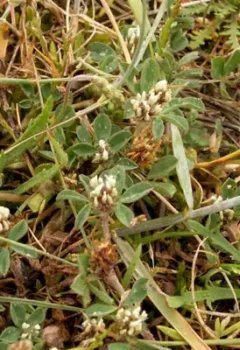
Rough clover is an annual forb that belongs to the legume family. True to its name, this plant has a distinctly rough, hairy texture that sets it apart from its smoother clover cousins. It’s a low-growing plant that forms small patches of ground cover, topped with clusters of tiny white to pale pink flowers.
Where Does It Grow?
Originally from the Mediterranean region and parts of Europe, rough clover has established itself in New Jersey, where it reproduces on its own without human intervention. It’s adapted well to sandy soils and can often be found in disturbed areas, roadsides, and open spaces.
- Species observed
- No observations
Garden Appeal and Landscape Role
Let’s be honest – rough clover isn’t going to win any beauty contests. Its flowers are small and rather inconspicuous, and the plant itself has a somewhat scrubby appearance. However, it does serve some practical purposes:
- Provides ground cover in challenging sandy soils
- Offers nectar for small bees and other pollinators
- Helps prevent soil erosion in disturbed areas
- Adds nitrogen to the soil through its root nodules
Growing Conditions
If you’re considering rough clover for your landscape, it’s remarkably easy to please. This hardy little plant thrives in:
- Sandy, well-drained soils
- Full sun locations
- Areas with minimal irrigation
- USDA hardiness zones 7-10
Once established, rough clover is quite drought tolerant and requires minimal care. In fact, it may be too low-maintenance for some gardeners’ tastes, as it can self-seed readily and spread to areas where it’s not wanted.
Should You Plant It?
The question of whether to plant rough clover depends on your gardening goals. While it’s not listed as invasive, it is a non-native species that has naturalized in North America. If you’re looking for ground cover that requires minimal care and can handle tough conditions, it might fit the bill for very casual, naturalized areas.
However, if you’re interested in supporting native ecosystems and wildlife, consider these native alternatives instead:
- Wild strawberry (Fragaria virginiana) for shaded areas
- Creeping phlox (Phlox subulata) for sunny slopes
- Native sedges for various soil conditions
The Bottom Line
Rough clover is a survivor – a small, tough plant that’s made itself at home in sandy soils where other plants might struggle. While it won’t transform your garden into a showstopper, it serves its purpose as a low-maintenance ground cover. Just remember that supporting native plants is generally the better choice for local wildlife and ecosystem health.