Russian Thistle: The Infamous Tumbleweed You Don’t Want in Your Garden
When most people think of tumbleweeds rolling across the Western landscape, they’re picturing Russian thistle (Salsola kali). Despite its iconic status in cowboy movies, this spiky annual plant is definitely not something you want to invite into your carefully planned garden space.
What Exactly Is Russian Thistle?
Russian thistle is an annual forb – essentially a non-woody plant that completes its entire life cycle in one growing season. Don’t let the name fool you though; this plant isn’t actually native to Russia or North America. It’s originally from the steppes and semi-arid regions of Eurasia, making it a non-native species that has become widely naturalized across much of North America.
This adaptable plant has made itself quite at home across a impressive range of states and provinces, including Alabama, California, Connecticut, Florida, Georgia, and many others, plus several Canadian provinces like Ontario, Quebec, and Nova Scotia. It’s particularly well-established in areas with disturbed soils and dry conditions.
- Species observed
- No observations
Why Russian Thistle Isn’t Garden Material
While Russian thistle might seem interesting with its eventual transformation into the classic spherical tumbleweed, there are several compelling reasons why you shouldn’t plant it:
- It’s weedy and aggressive: This plant thrives in poor conditions and can quickly take over disturbed areas
- Limited wildlife value: Despite its widespread presence, Russian thistle provides only 2-5% of the diet for large animals, small mammals, and terrestrial birds, with minimal cover benefits
- No pollinator benefits: The small, inconspicuous flowers are wind-pollinated and don’t attract beneficial insects
- Potential for spread: Once established, it readily self-seeds and can become difficult to control
Growing Conditions and Characteristics
Russian thistle is remarkably adaptable, thriving in USDA hardiness zones 4-9. It has a Facultative Upland wetland status across most regions, meaning it usually grows in non-wetland areas but can occasionally pop up in wetter spots. The plant prefers:
- Poor, sandy, or alkaline soils
- Full sun exposure
- Dry, drought-prone conditions
- Disturbed or waste ground
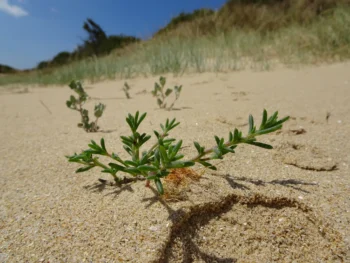
When young, Russian thistle forms a bushy, rounded plant with small, linear leaves. As it matures and dries out, it becomes the woody, spherical skeleton that breaks free from its roots and tumbles across the landscape, spreading seeds as it goes.
Better Native Alternatives
Instead of Russian thistle, consider these native alternatives that provide similar drought tolerance but offer much better ecological benefits:
- Native bunch grasses: Species like buffalo grass or blue grama provide structure and wildlife habitat
- Native wildflowers: Choose region-appropriate species that support local pollinators
- Native shrubs: Small native shrubs can provide the structural interest you might want without the invasive tendencies
If You Encounter Russian Thistle
If Russian thistle shows up uninvited in your garden (which it very well might), the best approach is removal before it sets seed. Young plants can be hand-pulled when the soil is moist, but be sure to wear gloves as the mature plants can be quite prickly.
While Russian thistle might have a certain Wild West charm, it’s definitely not a plant that belongs in thoughtful garden design. Stick with native alternatives that will provide better wildlife habitat, pollinator support, and long-term garden health. Your local ecosystem will thank you!