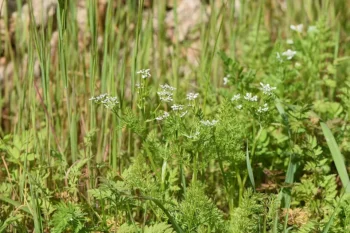
Shepherd’s Needle: A Delicate Annual with Old-World Charm
If you’ve ever stumbled across a delicate plant with feathery leaves and tiny white flowers that seems to pop up in the most unexpected places, you might have met shepherd’s needle (Scandix pectenveneris). This charming little annual has quite the travel story – it journeyed from its Mediterranean homeland to establish itself across much of North America, where it now grows wild and free.
What Is Shepherd’s Needle?
Shepherd’s needle is an annual forb belonging to the carrot family. Don’t let the forb label intimidate you – it simply means it’s a non-woody flowering plant that completes its entire life cycle in a single growing season. This petite plant produces delicate, lacy foliage and small clusters of white flowers that eventually give way to interesting seed pods that somewhat resemble, well, needles – hence the charming common name.
Where You’ll Find It Growing Wild
This adaptable little plant has made itself quite at home across a impressive range of North American locations. You can find shepherd’s needle growing wild in Alabama, Arizona, California, Florida, Georgia, Maryland, Massachusetts, Michigan, New Jersey, New York, North Carolina, Ohio, Oregon, Pennsylvania, Rhode Island, South Carolina, South Dakota, Tennessee, Texas, and Washington. It’s also established itself in Canadian provinces including British Columbia, Ontario, and Saskatchewan, plus the District of Columbia.
- Species observed
- No observations
A Note About Its Origins
Here’s where things get interesting from a gardening perspective: shepherd’s needle isn’t actually native to North America. It’s what botanists call a non-native species that has naturalized here, meaning it reproduces on its own without human help and has established persistent populations. While this doesn’t make it inherently problematic, it’s worth considering native alternatives that provide similar aesthetic appeal while supporting local ecosystems.
Garden Appeal and Growing Conditions
So why might you want to grow shepherd’s needle? This dainty annual offers several appealing qualities:
- Delicate, feathery foliage that adds texture to garden beds
- Small white flowers that attract beneficial insects
- Interesting seed pods that provide visual interest
- Low-maintenance nature once established
- Ability to fill in gaps in informal garden settings
Shepherd’s needle thrives in well-drained soils and prefers full sun to partial shade conditions. It’s surprisingly tolerant of poor soils, making it a good choice for challenging garden spots. As an annual, it’s generally hardy across USDA zones 3-9, though it completes its entire life cycle within a single growing season regardless of climate zone.
How to Grow Shepherd’s Needle
If you decide to give shepherd’s needle a try, here’s how to succeed:
- Seeding: Direct seed in fall or early spring when soil temperatures are cool
- Soil preparation: Ensure good drainage – this plant doesn’t like soggy feet
- Spacing: Scatter seeds lightly as they’re quite small
- Care: Once established, shepherd’s needle requires minimal care
- Self-seeding: Allow some plants to go to seed if you want them to return next year
Consider Native Alternatives
While shepherd’s needle can be an attractive garden addition, consider exploring native annual wildflowers that offer similar delicate beauty while supporting local wildlife. Native alternatives might include wild carrot relatives or other fine-textured annual flowers native to your specific region. These plants will integrate more seamlessly with local ecosystems and provide better support for native pollinators and other wildlife.
The Bottom Line
Shepherd’s needle offers old-world charm and low-maintenance appeal for gardeners drawn to delicate, naturalized plants. While it’s not native to North America, it has established itself as a gentle presence in many landscapes. Whether you choose to grow it or opt for native alternatives, the key is creating a garden that brings you joy while being mindful of the broader ecological picture.