Non-native Plants

Spear Saltbush

Atriplex patula

USDA symbol: ATPA4

annual forb

Alaska: non-native, naturalized
Canada: non-native, naturalized
Greenland: non-native, naturalized
Lower 48 states: non-native, naturalized
St. Pierre and Miquelon: non-native, naturalized

Meet spear saltbush, a scrappy little annual that’s probably tougher than your favorite houseplant and definitely more independent. Also known as spear orach, spear-scale, or spreading orache, this European native has made itself quite at home across North America—sometimes a little too at home for some gardeners’ liking. Spear saltbush ...

Spear Saltbush: A Hardy Annual You’ll Either Love or Pull

Meet spear saltbush, a scrappy little annual that’s probably tougher than your favorite houseplant and definitely more independent. Also known as spear orach, spear-scale, or spreading orache, this European native has made itself quite at home across North America—sometimes a little too at home for some gardeners’ liking.

What Exactly Is Spear Saltbush?

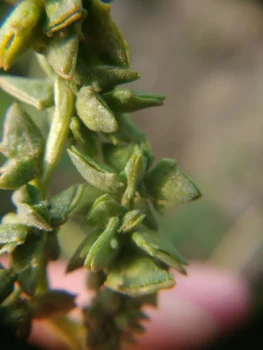
Spear saltbush (Atriplex patula) is an annual herb that belongs to the amaranth family. Don’t let the saltbush name fool you into expecting something spectacular—this plant is more about function than fashion. It sports triangular to diamond-shaped leaves with a distinctive grayish-green color, thanks to tiny scales that help it deal with salty conditions. The flowers are small, greenish, and cluster together in what botanists politely call inconspicuous displays.

Where You’ll Find This Persistent Pioneer

Originally from Europe and Asia, spear saltbush has become a naturalized citizen across most of North America. You can find it growing from Alaska down to Florida and from coast to coast, including most Canadian provinces. It’s particularly fond of disturbed soils, roadside areas, and anywhere conditions are a bit rough around the edges.

  • Species observed
  • No observations

This plant has earned its facultative wetland status across all regions, meaning it usually shows up in wetlands but isn’t picky enough to avoid drier spots when the mood strikes.

The Good, The Bad, and The Weedy

Here’s where things get interesting. Spear saltbush is incredibly adaptable and tough—qualities that can be either assets or headaches, depending on your perspective:

  • It thrives in poor, salty soils where other plants struggle
  • Requires virtually no care once established
  • Provides ground cover in disturbed areas
  • Self-seeds readily (which might be good or bad news)
  • Tolerates drought and harsh conditions

The downside? It’s not particularly pretty, offers minimal benefits to pollinators (being wind-pollinated), and can become weedy in garden settings.

Growing Conditions and Care

If you’re thinking about growing spear saltbush—or if it’s decided to grow itself in your garden—here’s what it likes:

  • Full sun exposure
  • Any soil type, including poor, sandy, or saline soils
  • Minimal water once established
  • USDA zones 3-9 (though as an annual, it’s more about growing season length)
  • No fertilizer needed (it actually prefers lean conditions)

Honestly, the biggest challenge with spear saltbush isn’t growing it—it’s controlling it if you change your mind later.

Should You Plant It?

While spear saltbush isn’t considered invasive or noxious, it’s also not a garden showstopper. If you’re dealing with challenging conditions like salty soils or disturbed areas where nothing else will grow, it might serve as a temporary ground cover solution.

However, before you embrace this European import, consider native alternatives that offer similar toughness with better ecological benefits:

  • Native Atriplex species in your region
  • Four o’clock (Mirabilis multiflora) for arid conditions
  • Seashore saltgrass (Distichlis spicata) for saline areas
  • Local native pioneers adapted to your specific conditions

The Bottom Line

Spear saltbush is like that reliable but unremarkable friend—dependable, low-maintenance, and always there when you need it, but probably not your first choice for a dinner party. If you encounter it in your garden, you can let it be or remove it without ecological guilt either way. Just remember that once it sets seed, you’ll likely have new volunteers next year.

For most gardeners, native alternatives will provide better wildlife benefits and stronger connections to local ecosystems. But if you’re dealing with truly challenging conditions and need something—anything—to grow there, spear saltbush might just be tough enough for the job.

Atriplex patula is also known as...

Often we refer to plants by their common names. When shopping for plants the scientific name is the best way to positively identify the plant species you desire. But some plants have more than one name! While it doesn't happen often, nurseries might display one name while you're searching for another. Atriplex patula is also known as:

Atriplex patula var. bracteata auct. non | USDA symbol: ATPAB
Atriplex patula var. erecta | USDA symbol: ATPAE
Atriplex patula var. japonica | USDA symbol: ATPAJ
Atriplex patula var. patula | USDA symbol: ATPAP3

Why do some plants have more than one name? Over time plant species may be renamed for a few reasons:

  1. Botanists in different regions named the same plant without knowing it had already been classified.
  2. A species was reclassified after scientific advances in, for example, DNA analysis.
  3. Slight variations within a species are sometimes mistakenly identified as entirely new species.

Wetland Status

The rule of seasoned gardeners and landscapers is to choose the "right plant for the right place" — matching plants to their ideal growing conditions, so they'll thrive with less care and fewer inputs. But the simplicity of this catchphrase conceals how tricky plant selection can be if you don't have the right information. While tags on nursery plants list watering requirements, there's more to the story.

Knowing a plant's wetland status can simplify the process by revealing the interaction between plants, water, and soil. You might be surprised to learn that popular landscape plants are wetland species! And what may be a wetland plant in one area, in another it might thrive in drier conditions. The table below gives insight into the preferred growing conditions of this plant throughout its geographical distribution.

Region
Preferred Habitat

Alaska ()

Facultative Wetland

Arid West (AZ, CA, CO, ID, MT, NV, NM, OR, TX, UT, WA, WY)

Facultative Wetland

Atlantic and Gulf Coastal Plain (AL, AR, DC, DE, FL, GA, IL, KY, LA, MD, MS, MO, NC, NJ, OK, PA, SC, TN, TX, VA)

Facultative Wetland

Eastern Mountains and Piedmont (AL, AR, DC, DE, GA, IL, IN, KS, KY, MD, MO, NC, NJ, NY, OH, OK, PA, SC, TN, VA, WV)

Facultative Wetland

Great Plains (CO, KS, MN, MT, NE, NM, ND, OK, SD, TX, WY)

Facultative Wetland

Midwest (IL, IN, IA, KS, KY, MI, MN, MO, NE, ND, OK, OH, SD, WI)

Facultative Wetland

Northcentral & Northeast ()

Facultative Wetland

Western Mountains, Valleys, and Coast (AZ, CA, CO, ID, MT, NV, NM, OR, SD, UT, WA, WY)

Facultative Wetland
Wetland Glossary
Obligate Wetland
Facultative Wetland
Facultative
Facultative Upland
Obligate Upland
Almost always occurs in wetlands
Usually occurs in wetlands but may occur in non-wetlands
Can occur in wetlands and non-wetlands
Usually occurs in non-wetlands but may occur in wetlands
Almost never occurs in wetlands

Classification

Group: Dicot
Kingdom: Plantae - Plants
Subkingdom: Tracheobionta - Vascular plants
Superdivision: Spermatophyta - Seed plants
Division: Magnoliophyta - Flowering plants
Class: Magnoliopsida - Dicotyledons
Subclass: Caryophyllidae
Order: Caryophyllales
Family: Chenopodiaceae Vent. - Goosefoot family
Genus: Atriplex L. - saltbush

Species: Atriplex patula L. - spear saltbush

Plant data source: USDA, NRCS 2025. The PLANTS Database. https://plants.usda.gov,. 2/25/2025. National Plant Data Team, Greensboro, NC USA