Star of Bethlehem: A Deceptively Pretty Problem Plant
With its charming white star-shaped flowers and innocent-sounding name, star of Bethlehem (Ornithogalum umbellatum) might seem like the perfect addition to your spring garden. But don’t let those pretty blooms fool you – this perennial bulb is a wolf in sheep’s clothing that can quickly become a gardener’s nightmare.
What is Star of Bethlehem?
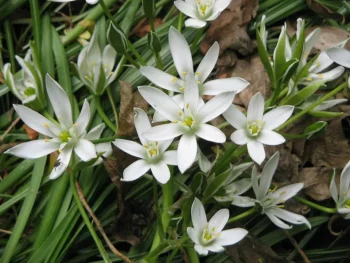
Star of Bethlehem is a perennial forb that produces clusters of distinctive white, six-petaled flowers in spring. Each bloom resembles a tiny star, hence the common name. You might also hear it called by its rather cheeky alternate name sleepydick – a reference to the flowers’ habit of closing in the afternoon and on cloudy days.
This plant grows 6-12 inches tall and spreads through underground bulbs, forming dense colonies over time. As a forb, it lacks woody tissue and dies back to the ground each winter, re-emerging in early spring with fresh green, grass-like leaves.
Where Does It Come From and Where Is It Now?
Originally native to the Mediterranean region, parts of Africa, and western Asia, star of Bethlehem has made itself thoroughly at home across North America. It now grows wild in most U.S. states and several Canadian provinces, including Alabama, Arkansas, California, Connecticut, Delaware, Florida, Georgia, Idaho, Illinois, Indiana, Iowa, Kansas, Kentucky, Louisiana, Maine, Maryland, Massachusetts, Michigan, Minnesota, Mississippi, Missouri, Nebraska, New Hampshire, New Jersey, New York, North Carolina, Ohio, Oklahoma, Oregon, Pennsylvania, Rhode Island, South Carolina, South Dakota, Tennessee, Texas, Utah, Vermont, Virginia, Washington, West Virginia, Wisconsin, British Columbia, New Brunswick, Nova Scotia, Ontario, Quebec, and Newfoundland.
- Species observed
- No observations
The Problem: It’s Invasive and Noxious
Here’s where things get serious. Star of Bethlehem isn’t just a non-native plant – it’s officially recognized as problematic:
- Connecticut lists it as Potentially Invasive
- Alabama classifies it as a Class C noxious weed
- It reproduces spontaneously in the wild and persists without human help
Once established, this plant spreads aggressively through bulb division, forming dense colonies that can crowd out native wildflowers and disrupt local ecosystems. The bulbs are also toxic to humans and animals if ingested, adding another layer of concern for families with children or pets.
Growing Conditions (But Please Don’t!)
Star of Bethlehem is frustratingly easy to grow – which is part of the problem. It thrives in USDA hardiness zones 4-9 and adapts to various growing conditions:
- Soil: Tolerates most soil types but prefers well-drained conditions
- Light: Partial to full sun
- Water: Facultative Upland status means it usually grows in non-wetland areas but can tolerate some moisture
- Care: Requires virtually no maintenance once established
Why You Should Skip This Plant
While star of Bethlehem offers early spring blooms when little else is flowering, the negatives far outweigh any aesthetic appeal:
- Extremely difficult to eradicate once established
- Crowds out native plants that support local wildlife
- Provides limited benefits to pollinators compared to native alternatives
- Toxic to humans and animals
- Can escape cultivation and invade natural areas
Better Native Alternatives
Instead of star of Bethlehem, consider these beautiful native spring bloomers that provide the same early-season interest without the invasive baggage:
- Bloodroot (Sanguinaria canadensis) – Pure white flowers with similar timing
- Dutchman’s Breeches (Dicentra cucullaria) – Charming white blooms
- Spring Beauty (Claytonia virginica) – Delicate pink-striped white flowers
- Wild Ginger (Asarum canadense) – Interesting foliage and unique flowers
- Trout Lily (Erythronium americanum) – Yellow blooms with mottled leaves
If You Already Have It
If star of Bethlehem has already invaded your garden, removal requires patience and persistence. Dig up all bulbs in fall after the foliage dies back, being careful to get every small bulblet. You may need to repeat this process for several years. Never compost the bulbs or dispose of them where they might establish elsewhere.
Star of Bethlehem is a perfect example of why we need to think beyond just pretty flowers when choosing plants for our gardens. By selecting native alternatives, we can enjoy beautiful spring blooms while supporting local ecosystems and avoiding future headaches. Your garden – and your local environment – will thank you for making the responsible choice.