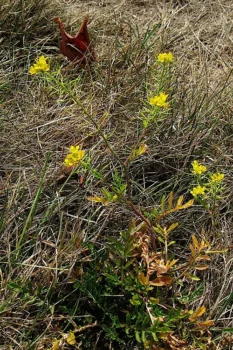
Tall Tumblemustard: The Wandering Weed You Probably Don’t Want to Plant
If you’ve ever wondered about that tall, scraggly plant with tiny yellow flowers taking over vacant lots and roadsides, you’ve likely encountered tall tumblemustard (Sisymbrium altissimum). This annual to biennial herb has quite the story to tell – and it’s not one most gardeners want to hear.
What Exactly Is Tall Tumblemustard?
Tall tumblemustard is a non-native forb that originally hails from Europe and Asia but has made itself thoroughly at home across North America. Also known by its scientific name Sisymbrium altissimum (or the synonym Norta altissima), this plant lives up to its tall moniker, often reaching 3 to 6 feet in height.
As a member of the mustard family, it produces clusters of small, four-petaled yellow flowers that eventually develop into long, narrow seed pods. These pods are the key to its success – and the reason it earned the tumble part of its name.
Where You’ll Find This Wanderer
Tall tumblemustard has spread far and wide across North America. You can find it in virtually every U.S. state and Canadian province, from Alaska to Florida, and from coast to coast. It’s also established itself in Hawaii and various territories.
- Species observed
- No observations
This widespread distribution isn’t accidental – tall tumblemustard is remarkably adaptable and thrives in disturbed soils, roadsides, vacant lots, and agricultural areas.
The Tumbling Lifestyle
Here’s where things get interesting (and potentially problematic). When tall tumblemustard matures, the entire plant breaks off at ground level and becomes a tumbleweed. As it rolls around in the wind, it disperses thousands of seeds across the landscape. It’s nature’s own seed-spreading machine!
The plant typically grows as an annual or biennial, completing its life cycle in one to two years. It’s classified as facultative upland across most regions, meaning it usually prefers non-wetland areas but can tolerate some moisture.
Should You Plant Tall Tumblemustard?
The short answer? Probably not. Here’s why:
- It’s an aggressive self-seeder that can quickly spread beyond where you want it
- It tends to dominate disturbed areas, potentially crowding out more desirable plants
- Its tumbling habit means you’ll have little control over where its seeds end up
- It’s considered weedy in most contexts
While tall tumblemustard isn’t officially classified as invasive in our database, its behavior certainly fits the bill in many situations.
Better Native Alternatives
Instead of tall tumblemustard, consider these native alternatives that offer similar heights and can fill ecological niches:
- Wild bergamot (Monarda fistulosa) – attracts pollinators and has aromatic foliage
- New England aster (Symphyotrichum novae-angliae) – provides late-season color and pollinator habitat
- Goldenrod species (Solidago spp.) – excellent for wildlife and fall color
- Wild lupine (Lupinus perennis) – beautiful flowers and important for certain butterfly species
If You’re Stuck With It
Sometimes tall tumblemustard shows up whether you want it or not. If you’re dealing with an established population:
- Cut plants before they set seed to prevent spread
- Remove young plants in early spring when they’re easier to pull
- Establish competitive native plants to reduce available growing space
- Avoid soil disturbance, which creates ideal conditions for germination
The Bottom Line
Tall tumblemustard is one of those plants that’s more interesting to observe than to cultivate. While its tumbling seed dispersal strategy is certainly clever from an evolutionary standpoint, it’s not something most gardeners want to encourage in their landscapes.
If you’re looking to create habitat for wildlife or add height to your garden, stick with native alternatives that will provide better ecological benefits without the risk of aggressive spread. Your local ecosystem – and your neighbors – will thank you for it!