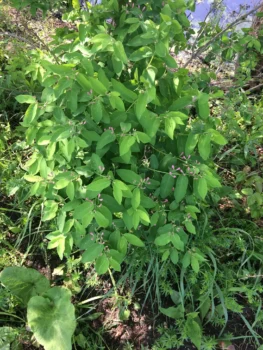
Tatarian Honeysuckle: A Beautiful Invader You Should Avoid in Your Garden
If you’ve ever been tempted by the sweet fragrance and pretty pink flowers of Tatarian honeysuckle (also called Tartarian honeysuckle), you’re not alone. This fast-growing shrub has charmed gardeners for decades with its showy blooms and bright red berries. But here’s the plot twist: this seemingly innocent plant is actually a garden villain in disguise.
What Is Tatarian Honeysuckle?
Tatarian honeysuckle is a perennial shrub that typically grows 6-9 feet tall and wide, though it can sometimes reach up to 13 feet under ideal conditions. This multi-stemmed woody plant produces fragrant tubular flowers in shades of pink, red, or white during mid to late spring, followed by conspicuous bright red berries in summer. The dense green foliage provides excellent screening capability, which is partly why it became popular in landscaping.
The Problem: It’s an Aggressive Invader
Here’s where things get serious. Despite its ornamental appeal, Tatarian honeysuckle is classified as an invasive species that poses significant ecological threats. Originally native to central Asia, Siberia, and parts of Russia and Mongolia, this plant has established itself across a huge swath of North America, from Alaska and most Canadian provinces to 41 U.S. states.
The invasive status varies by location, but several states have taken strong action:
- Connecticut lists it as Invasive, Prohibited
- Delaware classifies it as Invasive
- Missouri designates it as Invasive (IPC)
- New Hampshire has it listed as Prohibited
- Wisconsin restricts its sale and planting
- Species observed
- No observations
Why You Should Skip This Plant
Tatarian honeysuckle might seem like a gardener’s dream with its rapid growth rate and low maintenance needs, but it’s actually an ecological nightmare. This aggressive spreader can quickly take over natural areas, crowding out native plants that wildlife depends on. While the flowers do attract pollinators like bees, butterflies, and hummingbirds, and birds may eat the berries, the plant’s invasive nature means it disrupts entire ecosystems.
The shrub is remarkably adaptable, thriving in USDA hardiness zones 3-8 and tolerating a wide range of conditions. It grows well in coarse to medium-textured soils, handles moderate drought, and can tolerate both full sun and partial shade. This adaptability is exactly what makes it such a successful invader.
Growing Conditions (For Identification Purposes Only)
Understanding where Tatarian honeysuckle thrives can help you identify and remove it from your property:
- Soil: Adapts to coarse and medium-textured soils with pH between 5.2-7.5
- Water: Medium moisture requirements with moderate drought tolerance
- Light: Intermediate shade tolerance (grows in both sun and partial shade)
- Climate: Hardy in zones 3-8, tolerates temperatures as low as -38°F
- Wetland status: Generally prefers upland areas but can tolerate some wetland conditions
Better Native Alternatives
Instead of planting this invasive species, consider these native honeysuckle alternatives that provide similar benefits without the ecological damage:
- American honeysuckle (Lonicera americana) – Native vine with fragrant flowers
- Trumpet honeysuckle (Lonicera sempervirens) – Native vine with brilliant red tubular flowers loved by hummingbirds
- Limber honeysuckle (Lonicera dioica) – Native shrub perfect for woodland gardens
- Elderberry (Sambucus canadensis) – Native shrub with white flowers and dark berries
- Serviceberry (Amelanchier species) – Native shrubs with white flowers and excellent wildlife value
What to Do If You Have It
If Tatarian honeysuckle is already established in your landscape, the responsible thing to do is remove it. Small shrubs can be hand-pulled when the soil is moist, but larger specimens may require cutting and treating stumps with herbicide to prevent regrowth. Always dispose of plant material properly – never compost invasive species or dump them in natural areas.
Remember, gardening isn’t just about creating beautiful spaces for ourselves – we’re also stewards of the broader ecosystem. By choosing native plants over invasive species like Tatarian honeysuckle, we can create gardens that are both stunning and ecologically responsible.