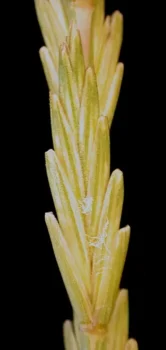
Non-native Plants

Tick Quackgrass

Thinopyrum pycnanthum

USDA symbol: THPY4

perennial grass

Canada: non-native, naturalized
Lower 48 states: non-native, naturalized

If you’ve stumbled across the name tick quackgrass in your plant research, you might be wondering what this somewhat oddly-named grass is all about. Scientifically known as Thinopyrum pycnanthum, this perennial grass has an interesting story that every native plant enthusiast should know. Tick quackgrass is a perennial graminoid – ...

Tick Quackgrass: What Every Gardener Should Know About This Non-Native Grass

If you’ve stumbled across the name tick quackgrass in your plant research, you might be wondering what this somewhat oddly-named grass is all about. Scientifically known as Thinopyrum pycnanthum, this perennial grass has an interesting story that every native plant enthusiast should know.

What is Tick Quackgrass?

Tick quackgrass is a perennial graminoid – that’s botanist-speak for a grass or grass-like plant. Like other members of the grass family, it’s a monocot with the characteristic narrow leaves and fibrous root system you’d expect. However, there’s an important detail that sets this species apart from many of our beloved native grasses.

The Non-Native Reality

Here’s where things get interesting (and a bit concerning): tick quackgrass isn’t actually native to North America. This European transplant has established itself across various regions and now reproduces on its own in the wild without any human help. It’s what botanists call a naturalized species – essentially, it’s made itself at home whether we invited it or not.

Where You’ll Find It

Tick quackgrass has spread across a surprisingly wide range of North American locations. You can find established populations in:

  • Canadian provinces: Alberta and Nova Scotia
  • Northeastern states: Maine, Massachusetts, New Hampshire, New York, Pennsylvania, Rhode Island
  • Western states: Oregon, Washington
  • As far south as Texas
  • Species observed
  • No observations

Wetland Connections

One notable characteristic of tick quackgrass is its relationship with wet areas. Across all regions where it’s found, this grass has a Facultative Wetland status. In plain English, this means it usually hangs out in wetlands but isn’t picky enough to avoid drier spots when the opportunity arises. This flexibility might help explain how it’s managed to establish itself across such diverse geographic areas.

Should You Plant It?

Here’s where we need to have an honest conversation. While tick quackgrass isn’t currently listed as invasive or noxious (at least in available databases), its non-native status gives us pause. As native plant advocates, we believe there are compelling reasons to look toward our homegrown alternatives instead.

The truth is, there’s limited information available about this species’ garden performance, care requirements, or ecological benefits. When you’re investing time and energy into your landscape, why not choose plants with proven track records that also support local ecosystems?

Better Native Alternatives

Instead of tick quackgrass, consider these fantastic native grass options that will give you beauty and ecological benefits:

  • For wetland areas: Try native sedges like fox sedge or bladder sedge
  • For prairie-style plantings: Little bluestem and buffalo grass are stunners
  • For coastal areas: Beach grass species native to your region
  • For general landscaping: Native fescues and bunch grasses

The Bottom Line

While tick quackgrass might not be the villain of the plant world, it’s not exactly the hero of your native garden story either. With so many gorgeous native grasses available that support local wildlife, improve soil health, and provide stunning seasonal interest, there’s really no compelling reason to choose this European import.

If you’re passionate about creating landscapes that support local ecosystems while looking absolutely gorgeous, stick with the natives. Your local birds, butterflies, and beneficial insects will thank you, and you’ll have the satisfaction of knowing your garden is truly working in harmony with its environment.

Remember, every plant choice is a vote for the kind of landscape – and world – we want to create. Why not cast your vote for the home team?

Thinopyrum pycnanthum is also known as...

Often we refer to plants by their common names. When shopping for plants the scientific name is the best way to positively identify the plant species you desire. But some plants have more than one name! While it doesn't happen often, nurseries might display one name while you're searching for another. Thinopyrum pycnanthum is also known as:

Agropyron campestre & | USDA symbol: AGCA13
Agropyron littorale auct. non | USDA symbol: AGLI81
Agropyron pungens auct. non & | USDA symbol: AGPU3
Agropyron pungens & var. acadiense | USDA symbol: AGPUA
Agropyron pycnanthum & | USDA symbol: AGPY80
Elytrigia pungens auct. non | USDA symbol: ELPU3
Elymus pungens auct. non | USDA symbol: ELPU4
Elytrigia pycnanthes Á. Löve, orth. var. | USDA symbol: ELPY2
Elytrigia pycnantha Á. Löve | USDA symbol: ELPY3
Elymus pycnanthus | USDA symbol: ELPY80

Why do some plants have more than one name? Over time plant species may be renamed for a few reasons:

  1. Botanists in different regions named the same plant without knowing it had already been classified.
  2. A species was reclassified after scientific advances in, for example, DNA analysis.
  3. Slight variations within a species are sometimes mistakenly identified as entirely new species.

Wetland Status

The rule of seasoned gardeners and landscapers is to choose the "right plant for the right place" — matching plants to their ideal growing conditions, so they'll thrive with less care and fewer inputs. But the simplicity of this catchphrase conceals how tricky plant selection can be if you don't have the right information. While tags on nursery plants list watering requirements, there's more to the story.

Knowing a plant's wetland status can simplify the process by revealing the interaction between plants, water, and soil. You might be surprised to learn that popular landscape plants are wetland species! And what may be a wetland plant in one area, in another it might thrive in drier conditions. The table below gives insight into the preferred growing conditions of this plant throughout its geographical distribution.

Region
Preferred Habitat

Atlantic and Gulf Coastal Plain (AL, AR, DC, DE, FL, GA, IL, KY, LA, MD, MS, MO, NC, NJ, OK, PA, SC, TN, TX, VA)

Facultative Wetland

Eastern Mountains and Piedmont (AL, AR, DC, DE, GA, IL, IN, KS, KY, MD, MO, NC, NJ, NY, OH, OK, PA, SC, TN, VA, WV)

Facultative Wetland

Northcentral & Northeast ()

Facultative Wetland

Western Mountains, Valleys, and Coast (AZ, CA, CO, ID, MT, NV, NM, OR, SD, UT, WA, WY)

Facultative Wetland
Wetland Glossary
Obligate Wetland
Facultative Wetland
Facultative
Facultative Upland
Obligate Upland
Almost always occurs in wetlands
Usually occurs in wetlands but may occur in non-wetlands
Can occur in wetlands and non-wetlands
Usually occurs in non-wetlands but may occur in wetlands
Almost never occurs in wetlands

Classification

Group: Monocot
Kingdom: Plantae - Plants
Subkingdom: Tracheobionta - Vascular plants
Superdivision: Spermatophyta - Seed plants
Division: Magnoliophyta - Flowering plants
Class: Liliopsida - Monocotyledons
Subclass: Commelinidae
Order: Cyperales
Family: Poaceae Barnhart - Grass family
Genus: Thinopyrum Á. Löve - wheatgrass

Species: Thinopyrum pycnanthum (Godr.) Barkworth - tick quackgrass

Plant data source: USDA, NRCS 2025. The PLANTS Database. https://plants.usda.gov,. 2/25/2025. National Plant Data Team, Greensboro, NC USA