Non-native Plants

Tuberous Bulrush

Bolboschoenus glaucus

USDA symbol: BOGL9

perennial grass

Lower 48 states: non-native, naturalized

If you’re diving into the world of wetland gardening or looking to create a naturalistic water feature, you might have come across tuberous bulrush (Bolboschoenus glaucus). This perennial sedge has found its way into various wetland restoration projects across the United States, though it’s not actually a native species. Tuberous ...

Tuberous Bulrush: A Wetland Sedge for Water Gardens

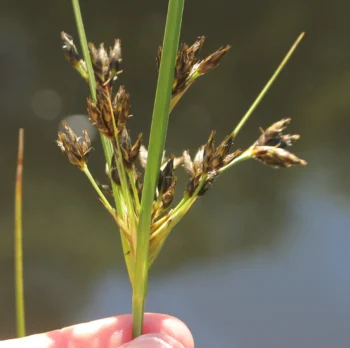
If you’re diving into the world of wetland gardening or looking to create a naturalistic water feature, you might have come across tuberous bulrush (Bolboschoenus glaucus). This perennial sedge has found its way into various wetland restoration projects across the United States, though it’s not actually a native species.

What is Tuberous Bulrush?

Tuberous bulrush is a grass-like perennial that belongs to the sedge family. You might also see it listed under several scientific synonyms, including Schoenoplectus glaucus or Scirpus glaucus, which can make plant identification a bit of a detective game! Despite its common name suggesting it’s a true bulrush, this plant is actually a sedge with a distinctive tuberous root system.

Where Does It Grow?

Originally from the Mediterranean region and parts of Europe and Asia, tuberous bulrush has established itself in several U.S. states, including California, Idaho, New Jersey, New York, and Oregon. It’s what botanists call a naturalized species – meaning it reproduces on its own in the wild without human help and tends to stick around.

  • Species observed
  • No observations

A True Water Lover

Here’s where tuberous bulrush really shines: it absolutely loves wet feet! This plant has an Obligate Wetland status across all regions of the United States, which is a fancy way of saying it almost always grows in wetlands. If you see this plant growing somewhere, you can bet there’s water nearby – either on the surface or just below ground.

Garden Potential and Considerations

So, should you plant tuberous bulrush in your garden? Here’s the scoop:

The Good:

  • Excellent for wetland restoration projects and rain gardens
  • Thrives in consistently wet conditions where other plants struggle
  • Low maintenance once established
  • Helps with erosion control along pond edges
  • Hardy in USDA zones 6-9

The Not-So-Good:

  • Limited aesthetic appeal with inconspicuous brownish flowers
  • Minimal value for pollinators (it’s wind-pollinated)
  • As a non-native species, it doesn’t support native wildlife as effectively as indigenous plants

Growing Tuberous Bulrush Successfully

If you decide to grow tuberous bulrush, here’s what it needs to thrive:

  • Light: Full sun to partial shade
  • Water: Consistently moist to wet soil – think bog conditions
  • Soil: Tolerates various soil types as long as they stay wet
  • Planting: Best planted in spring when growth begins
  • Care: Very low maintenance; mainly just ensure consistent moisture

Consider Native Alternatives

While tuberous bulrush can serve a purpose in wetland gardens, consider these native sedge alternatives that provide similar benefits while supporting local ecosystems:

  • River bulrush (Bolboschoenus fluviatilis) – a native cousin
  • Hardstem bulrush (Schoenoplectus acutus)
  • Soft-stem bulrush (Schoenoplectus tabernaemontani)
  • Various native Carex species for your region

The Bottom Line

Tuberous bulrush fills a specific niche for gardeners dealing with very wet conditions or working on wetland restoration. While it’s not invasive, choosing native alternatives will better support your local wildlife and maintain the ecological integrity of your garden. If you do choose to plant it, you’ll find it’s a reliable, if unassuming, addition to water gardens and soggy spots where little else will grow.

Remember, successful wetland gardening is all about working with water rather than against it – and tuberous bulrush certainly knows how to do that!

Bolboschoenus glaucus is also known as...

Often we refer to plants by their common names. When shopping for plants the scientific name is the best way to positively identify the plant species you desire. But some plants have more than one name! While it doesn't happen often, nurseries might display one name while you're searching for another. Bolboschoenus glaucus is also known as:

Schoenoplectus glaucus | USDA symbol: SCGL11
Scirpus glaucus | USDA symbol: SCGL12
Scirpus maritimus var. tuberosus auct. non & | USDA symbol: SCMAT
Scirpus tuberosus auct. non | USDA symbol: SCTU4

Why do some plants have more than one name? Over time plant species may be renamed for a few reasons:

  1. Botanists in different regions named the same plant without knowing it had already been classified.
  2. A species was reclassified after scientific advances in, for example, DNA analysis.
  3. Slight variations within a species are sometimes mistakenly identified as entirely new species.

Wetland Status

The rule of seasoned gardeners and landscapers is to choose the "right plant for the right place" — matching plants to their ideal growing conditions, so they'll thrive with less care and fewer inputs. But the simplicity of this catchphrase conceals how tricky plant selection can be if you don't have the right information. While tags on nursery plants list watering requirements, there's more to the story.

Knowing a plant's wetland status can simplify the process by revealing the interaction between plants, water, and soil. You might be surprised to learn that popular landscape plants are wetland species! And what may be a wetland plant in one area, in another it might thrive in drier conditions. The table below gives insight into the preferred growing conditions of this plant throughout its geographical distribution.

Region
Preferred Habitat

Arid West (AZ, CA, CO, ID, MT, NV, NM, OR, TX, UT, WA, WY)

Obligate Wetland

Atlantic and Gulf Coastal Plain (AL, AR, DC, DE, FL, GA, IL, KY, LA, MD, MS, MO, NC, NJ, OK, PA, SC, TN, TX, VA)

Obligate Wetland

Eastern Mountains and Piedmont (AL, AR, DC, DE, GA, IL, IN, KS, KY, MD, MO, NC, NJ, NY, OH, OK, PA, SC, TN, VA, WV)

Obligate Wetland

Northcentral & Northeast ()

Obligate Wetland

Western Mountains, Valleys, and Coast (AZ, CA, CO, ID, MT, NV, NM, OR, SD, UT, WA, WY)

Obligate Wetland
Wetland Glossary
Obligate Wetland
Facultative Wetland
Facultative
Facultative Upland
Obligate Upland
Almost always occurs in wetlands
Usually occurs in wetlands but may occur in non-wetlands
Can occur in wetlands and non-wetlands
Usually occurs in non-wetlands but may occur in wetlands
Almost never occurs in wetlands

Classification

Group: Monocot
Kingdom: Plantae - Plants
Subkingdom: Tracheobionta - Vascular plants
Superdivision: Spermatophyta - Seed plants
Division: Magnoliophyta - Flowering plants
Class: Liliopsida - Monocotyledons
Subclass: Commelinidae
Order: Cyperales
Family: Cyperaceae Juss. - Sedge family
Genus: Bolboschoenus (Asch.) Palla - bulrush

Species: Bolboschoenus glaucus (Lam.) S.G. Sm. - tuberous bulrush

Plant data source: USDA, NRCS 2025. The PLANTS Database. https://plants.usda.gov,. 2/25/2025. National Plant Data Team, Greensboro, NC USA