Non-native Plants

Umbrella Plant

Cyperus involucratus

USDA symbol: CYIN6

perennial grass

Hawaii: non-native, naturalized
Lower 48 states: non-native, naturalized
Pacific Basin excluding Hawaii: non-native, naturalized
Puerto Rico: non-native, naturalized
U.S. Virgin Islands: non-native, naturalized

If you’re looking for a plant that makes a bold architectural statement in your garden, the umbrella plant (Cyperus involucratus) might just catch your eye. With its distinctive spoke-like foliage radiating from tall stems like nature’s own umbrella, this perennial sedge brings a unique tropical flair wherever it grows. The ...

Umbrella Plant: A Striking Water Garden Addition

If you’re looking for a plant that makes a bold architectural statement in your garden, the umbrella plant (Cyperus involucratus) might just catch your eye. With its distinctive spoke-like foliage radiating from tall stems like nature’s own umbrella, this perennial sedge brings a unique tropical flair wherever it grows.

What is the Umbrella Plant?

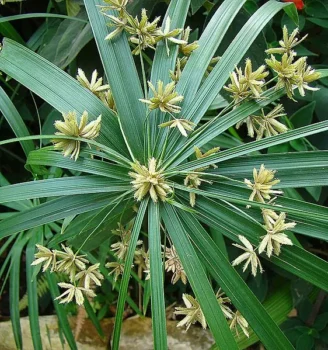
The umbrella plant belongs to the sedge family, making it a grass-like plant rather than a true grass. You might also hear it called by its Hawaiian names ‘ahu’awa haole or pu’uka’a haole. This perennial creates its signature look through narrow, strap-like leaves arranged in perfect whorls at the tips of triangular stems, resembling the ribs of an umbrella.

Where Does It Come From?

Originally native to Madagascar and parts of Africa, the umbrella plant has traveled far from home. It’s now established as a non-native species that reproduces naturally in many warm regions, including Hawaii, the lower 48 states, Puerto Rico, and the U.S. Virgin Islands. You’ll find it growing in states from Arizona and California to Florida and New York, plus territories like Guam and Palau.

  • Species observed
  • No observations

Why Gardeners Love (and Sometimes Worry About) Umbrella Plants

The umbrella plant’s architectural form makes it a standout choice for gardeners wanting something different. Its upright stems topped with radiating foliage create vertical interest and a distinctly tropical feel. However, since it’s not native to North America, some gardeners prefer to choose indigenous alternatives that better support local ecosystems.

Pros:

  • Striking architectural form adds drama to landscapes
  • Thrives in wet conditions where other plants struggle
  • Low maintenance once established
  • Excellent for water features and bog gardens

Consider instead: If you’re focused on native gardening, look for indigenous sedges like Carex species or native rushes that provide similar texture while supporting local wildlife.

Perfect Spots for Umbrella Plants

This moisture-loving plant shines in specific garden situations:

  • Water gardens: Plant along pond edges or in shallow water
  • Rain gardens: Helps manage wet spots in the landscape
  • Container gardens: Makes a dramatic statement in large pots
  • Tropical-themed landscapes: Adds authentic tropical texture

The umbrella plant’s wetland status varies by region – it’s considered an obligate wetland plant in some areas (almost always found in wetlands) and facultative wetland in others (usually in wetlands but can handle drier spots).

Growing Conditions and Care

Success with umbrella plants comes down to understanding their love affair with water:

Climate: Hardy in USDA zones 9-11, though you can grow it as an annual or houseplant in cooler areas

Light: Full sun to partial shade – it’s quite adaptable

Soil: Constantly moist to wet conditions are essential. It can even grow in standing water up to several inches deep

Care tips:

  • Never let the soil completely dry out
  • In colder zones, bring container plants indoors or treat as annuals
  • Divide clumps every few years to maintain vigor
  • Remove dead stems to keep plants looking fresh

Wildlife and Pollinator Value

While umbrella plants produce small, inconspicuous flowers that are wind-pollinated rather than attractive to bees and butterflies, they can provide habitat structure for wetland wildlife. However, native plants typically offer more significant benefits to local ecosystems.

The Bottom Line

The umbrella plant offers undeniable visual appeal for gardeners wanting to create dramatic water features or tropical-style gardens. While it’s not native to North America, it’s not currently listed as invasive either. If you choose to grow it, you’ll have a relatively low-maintenance plant that thrives in wet conditions where many others fail. Just remember to consider native alternatives that might better serve your local wildlife while still providing the texture and interest you’re after.

Cyperus involucratus is also known as...

Often we refer to plants by their common names. When shopping for plants the scientific name is the best way to positively identify the plant species you desire. But some plants have more than one name! While it doesn't happen often, nurseries might display one name while you're searching for another. Cyperus involucratus is also known as:

Cyperus alternifolius auct. non | USDA symbol: CYAL2
Cyperus alternifolius ssp. flabelliformis Kük. | USDA symbol: CYALF
Cyperus flabelliformis | USDA symbol: CYFL8

Why do some plants have more than one name? Over time plant species may be renamed for a few reasons:

  1. Botanists in different regions named the same plant without knowing it had already been classified.
  2. A species was reclassified after scientific advances in, for example, DNA analysis.
  3. Slight variations within a species are sometimes mistakenly identified as entirely new species.

Wetland Status

The rule of seasoned gardeners and landscapers is to choose the "right plant for the right place" — matching plants to their ideal growing conditions, so they'll thrive with less care and fewer inputs. But the simplicity of this catchphrase conceals how tricky plant selection can be if you don't have the right information. While tags on nursery plants list watering requirements, there's more to the story.

Knowing a plant's wetland status can simplify the process by revealing the interaction between plants, water, and soil. You might be surprised to learn that popular landscape plants are wetland species! And what may be a wetland plant in one area, in another it might thrive in drier conditions. The table below gives insight into the preferred growing conditions of this plant throughout its geographical distribution.

Region
Preferred Habitat

Arid West (AZ, CA, CO, ID, MT, NV, NM, OR, TX, UT, WA, WY)

Facultative Wetland

Atlantic and Gulf Coastal Plain (AL, AR, DC, DE, FL, GA, IL, KY, LA, MD, MS, MO, NC, NJ, OK, PA, SC, TN, TX, VA)

Obligate Wetland

Caribbean (PR, VI)

Obligate Wetland

Eastern Mountains and Piedmont (AL, AR, DC, DE, GA, IL, IN, KS, KY, MD, MO, NC, NJ, NY, OH, OK, PA, SC, TN, VA, WV)

Facultative Wetland

Great Plains (CO, KS, MN, MT, NE, NM, ND, OK, SD, TX, WY)

Facultative Wetland

Hawaii ()

Facultative Wetland

Midwest (IL, IN, IA, KS, KY, MI, MN, MO, NE, ND, OK, OH, SD, WI)

Facultative Wetland

Northcentral & Northeast ()

Obligate Wetland

Western Mountains, Valleys, and Coast (AZ, CA, CO, ID, MT, NV, NM, OR, SD, UT, WA, WY)

Facultative Wetland
Wetland Glossary
Obligate Wetland
Facultative Wetland
Facultative
Facultative Upland
Obligate Upland
Almost always occurs in wetlands
Usually occurs in wetlands but may occur in non-wetlands
Can occur in wetlands and non-wetlands
Usually occurs in non-wetlands but may occur in wetlands
Almost never occurs in wetlands

Classification

Group: Monocot
Kingdom: Plantae - Plants
Subkingdom: Tracheobionta - Vascular plants
Superdivision: Spermatophyta - Seed plants
Division: Magnoliophyta - Flowering plants
Class: Liliopsida - Monocotyledons
Subclass: Commelinidae
Order: Cyperales
Family: Cyperaceae Juss. - Sedge family
Genus: Cyperus L. - flatsedge

Species: Cyperus involucratus Rottb. - umbrella plant

Plant data source: USDA, NRCS 2025. The PLANTS Database. https://plants.usda.gov,. 2/25/2025. National Plant Data Team, Greensboro, NC USA