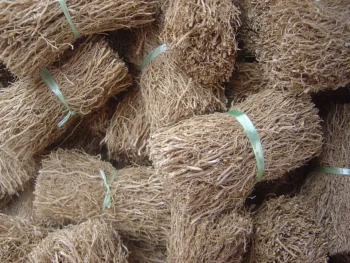
Non-native Plants

Vetivergrass

Vetiveria zizanioides

USDA symbol: VEZI80

perennial grass

Lower 48 states: non-native, naturalized
Pacific Basin excluding Hawaii: non-native, naturalized
Puerto Rico: non-native, naturalized

Meet vetivergrass (Vetiveria zizanioides), a tough-as-nails perennial grass that’s like the superhero of slope stabilization. While it might not be the prettiest plant in your garden lineup, this workhorse grass has some serious skills when it comes to holding soil together and thriving in challenging conditions. Vetivergrass is a robust ...

Vetivergrass: The Erosion-Fighting Grass That Means Business

Meet vetivergrass (Vetiveria zizanioides), a tough-as-nails perennial grass that’s like the superhero of slope stabilization. While it might not be the prettiest plant in your garden lineup, this workhorse grass has some serious skills when it comes to holding soil together and thriving in challenging conditions.

What Exactly Is Vetivergrass?

Vetivergrass is a robust perennial grass that forms dense, fountain-like clumps reaching up to 7 feet tall. You might also see it listed under its synonyms Chrysopogon zizanioides or Anatherum zizanioides. This grass grows in distinctive bunches with narrow, arching green leaves and produces inconspicuous purple flower heads in late summer.

Originally native to India and tropical Asia, vetivergrass has established itself as a non-native species in several U.S. locations, including Louisiana, Texas, Puerto Rico, Guam, and Palau, where it reproduces and persists without human intervention.

  • Species observed
  • No observations

Why Consider (or Skip) Vetivergrass?

Here’s the deal with vetivergrass: it’s incredibly functional but not particularly ornamental. Consider it if you need:

  • Serious erosion control on slopes or banks
  • A plant that laughs in the face of drought
  • Quick-growing privacy screening
  • Soil stabilization in challenging locations

However, since vetivergrass isn’t native to most U.S. regions, you might want to explore native alternatives first. Native bunch grasses like little bluestem, buffalo grass, or regional sedges often provide similar erosion control benefits while supporting local wildlife.

Growing Conditions That Make Vetivergrass Happy

If you decide vetivergrass fits your needs, you’ll be pleased to know it’s remarkably adaptable:

  • Climate: USDA zones 9-11 (needs year-round growing season)
  • Soil: Accepts everything from clay to sand, pH 3.0-8.0
  • Water: Drought-tolerant once established, low moisture needs
  • Sun: Full sun to partial shade
  • Fertility: Low requirements (doesn’t need rich soil)

This grass is classified as facultative wetland in most regions, meaning it’s equally happy in wet spots or well-drained areas.

Planting and Care Tips

Vetivergrass is refreshingly low-maintenance:

  • Planting: Available as seeds, containerized plants, bare root, or sprigs
  • Spacing: Plant 4,800-11,000 plants per acre depending on your goals
  • Growth rate: Rapid establishment
  • Root depth: Develops deep roots (minimum 24 inches)
  • Maintenance: Minimal once established

The grass maintains its foliage year-round in warm climates, with dense summer growth that becomes more moderate in winter.

The Bottom Line

Vetivergrass is a specialized tool rather than a general garden plant. While it excels at erosion control and thrives in difficult conditions, it offers limited aesthetic appeal and minimal benefits to pollinators and wildlife. Before planting, consider whether native alternatives might serve your landscape needs while better supporting your local ecosystem.

If you do choose vetivergrass for its practical benefits, you’ll get a reliable, drought-tolerant performer that asks for very little while delivering serious soil-holding power.

Vetiveria zizanioides is also known as...

Often we refer to plants by their common names. When shopping for plants the scientific name is the best way to positively identify the plant species you desire. But some plants have more than one name! While it doesn't happen often, nurseries might display one name while you're searching for another. Vetiveria zizanioides is also known as:

Anatherum zizanioides & | USDA symbol: ANZI
Chrysopogon zizanioides | USDA symbol: CHZI
Phalaris zizanioides | USDA symbol: PHZI

Why do some plants have more than one name? Over time plant species may be renamed for a few reasons:

  1. Botanists in different regions named the same plant without knowing it had already been classified.
  2. A species was reclassified after scientific advances in, for example, DNA analysis.
  3. Slight variations within a species are sometimes mistakenly identified as entirely new species.

Wetland Status

The rule of seasoned gardeners and landscapers is to choose the "right plant for the right place" — matching plants to their ideal growing conditions, so they'll thrive with less care and fewer inputs. But the simplicity of this catchphrase conceals how tricky plant selection can be if you don't have the right information. While tags on nursery plants list watering requirements, there's more to the story.

Knowing a plant's wetland status can simplify the process by revealing the interaction between plants, water, and soil. You might be surprised to learn that popular landscape plants are wetland species! And what may be a wetland plant in one area, in another it might thrive in drier conditions. The table below gives insight into the preferred growing conditions of this plant throughout its geographical distribution.

Region
Preferred Habitat

Atlantic and Gulf Coastal Plain (AL, AR, DC, DE, FL, GA, IL, KY, LA, MD, MS, MO, NC, NJ, OK, PA, SC, TN, TX, VA)

Facultative Wetland

Caribbean (PR, VI)

Facultative

Great Plains (CO, KS, MN, MT, NE, NM, ND, OK, SD, TX, WY)

Facultative Wetland
Wetland Glossary
Obligate Wetland
Facultative Wetland
Facultative
Facultative Upland
Obligate Upland
Almost always occurs in wetlands
Usually occurs in wetlands but may occur in non-wetlands
Can occur in wetlands and non-wetlands
Usually occurs in non-wetlands but may occur in wetlands
Almost never occurs in wetlands

Classification

Group: Monocot
Kingdom: Plantae - Plants
Subkingdom: Tracheobionta - Vascular plants
Superdivision: Spermatophyta - Seed plants
Division: Magnoliophyta - Flowering plants
Class: Liliopsida - Monocotyledons
Subclass: Commelinidae
Order: Cyperales
Family: Poaceae Barnhart - Grass family
Genus: Vetiveria Bory - vetivergrass

Species: Vetiveria zizanioides (L.) Nash - vetivergrass

Plant data source: USDA, NRCS 2025. The PLANTS Database. https://plants.usda.gov,. 2/25/2025. National Plant Data Team, Greensboro, NC USA