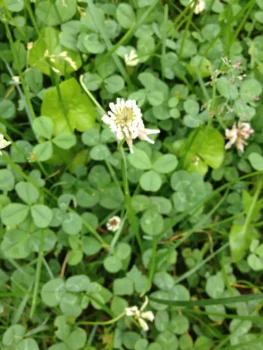
White Clover: The Humble Ground Cover That’s More Than Meets the Eye
If you’ve ever walked across a lawn and noticed small white flowers dotting the green carpet beneath your feet, chances are you’ve encountered white clover (Trifolium repens). This unassuming little plant has been quietly making its way across North America for centuries, and while it might not be native to our continent, it’s certainly made itself at home.
What Exactly Is White Clover?
White clover, also known by several other common names including Dutch clover, ladino clover, and white Dutch clover, is a perennial forb that grows as a low-spreading ground cover. Unlike woody plants, this herbaceous perennial lacks significant woody tissue and keeps its growing points at or below ground level, helping it survive through winter months.
This prostrate little plant typically reaches only about 6 inches tall but spreads horizontally through stolons (above-ground runners), creating that characteristic carpet-like appearance. Its moderate growth rate means it won’t take over overnight, but give it time and it’ll fill in nicely.
Where Does White Clover Come From?
Here’s where things get interesting: white clover isn’t actually native to North America. Originally from Europe and central Asia, this hardy little plant has become naturalized across an impressive range. It now grows throughout Canada (from British Columbia to Newfoundland), all 50 U.S. states, and even Alaska, Hawaii, and Greenland. That’s quite the travel resume!
- Species observed
- No observations
Should You Plant White Clover in Your Garden?
This is where gardeners often find themselves in a bit of a pickle. White clover brings some genuinely useful benefits to the table, but as a non-native species, it’s worth considering native alternatives too.
The Good Stuff
- Pollinator magnet: Those small white flower clusters are absolute bee magnets, providing excellent nectar for honeybees, native bees, and butterflies
- Nitrogen fixing: Thanks to its relationship with soil bacteria, white clover actually improves soil fertility by converting atmospheric nitrogen into plant-available forms
- Wildlife food: It provides 5-10% of the diet for various large animals, small mammals, and terrestrial birds
- Low maintenance: Once established, it’s quite drought-tolerant and requires minimal care
- Natural lawn alternative: Creates a lush, green carpet that stays relatively short
Things to Consider
While white clover isn’t considered invasive or noxious, it’s worth noting that native alternatives like wild white clover or other native legumes might better support local ecosystems. If you’re committed to native gardening, consider researching indigenous clover species in your area.
Growing Conditions and Care
White clover is surprisingly adaptable, which explains its widespread distribution. Here’s what it prefers:
- Hardiness: Thrives in USDA zones 3-10 (can tolerate temperatures down to -62°F!)
- Soil: Prefers medium to fine-textured soils with high fertility
- pH: Adaptable to pH ranges from 5.2 to 8.0
- Moisture: Needs consistent moisture (24-70 inches of precipitation annually) and has low drought tolerance
- Light: Full sun preferred – it’s quite shade intolerant
- Wetland status: Generally found in upland areas but can tolerate some wetness
How to Plant and Care for White Clover
Getting Started
White clover is typically grown from seed, and the good news is it’s routinely available from commercial sources. With about 711,867 seeds per pound, a little goes a long way! Here’s how to get started:
- Timing: Plant in late spring when soil has warmed
- Seeding: Scatter seeds over prepared soil and lightly rake in
- Germination: Seeds have low initial vigor but will establish with patience
- Establishment: Keep soil consistently moist until seedlings are established
Ongoing Care
One of white clover’s best features is how little maintenance it requires:
- Watering: Provide regular water, especially during dry spells
- Fertilizing: Thanks to its nitrogen-fixing ability, it rarely needs additional fertilizer
- Mowing: Can be mowed like a lawn if desired – it has rapid regrowth after cutting
- Winter care: No special winter protection needed in appropriate zones
Perfect Places for White Clover
White clover works beautifully in several landscape situations:
- Eco-lawns: Mixed with grass or on its own for a low-maintenance lawn alternative
- Meadow gardens: Adds gentle texture and pollinator value
- Naturalized areas: Perfect for informal, low-maintenance spaces
- Erosion control: Its spreading habit helps stabilize soil
- Children’s play areas: Soft underfoot and more forgiving than traditional turf
The Bottom Line
White clover might not be native, but it’s been a quiet garden companion for generations. If you’re looking for a low-maintenance ground cover that supports pollinators and improves soil health, it’s worth considering. Just remember to explore native alternatives first – your local ecosystem will thank you for it.
Whether you choose white clover or a native alternative, you’ll be adding a hardworking little plant that proves sometimes the most valuable garden residents are the ones that work quietly behind the scenes.