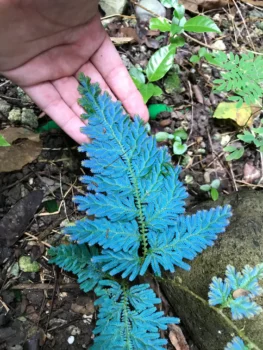
Willdenow’s Spikemoss: The Ancient Ground Cover That’s Not Actually Moss
Meet Willdenow’s spikemoss (Selaginella willdenowii), a fascinating little plant that’s been fooling people with its name for ages. Despite what its common name suggests, this isn’t a moss at all – it’s actually a lycophyte, an ancient group of plants that’s been around since before dinosaurs roamed the Earth. Pretty cool, right?
What Exactly Is Willdenow’s Spikemoss?
This perennial plant is what botanists call a living fossil. As a member of the lycophyte family, it’s more closely related to ferns than to true mosses. Willdenow’s spikemoss grows as a low, creeping herb that forms dense, carpet-like mats. It’s covered in tiny, scale-like leaves that give it a delicate, almost prehistoric appearance.
The plant typically stays quite small, reaching only 2-6 inches in height, but it can spread horizontally to create substantial ground coverage. Its intricate, branching pattern and fine texture make it look like nature’s own living tapestry.
Where You’ll Find It
Originally from tropical regions of Asia, Willdenow’s spikemoss has made itself at home in warmer parts of the United States. You can currently find it growing wild in Florida and Puerto Rico, where it has established itself as a non-native species that reproduces successfully without human intervention.
- Species observed
- No observations
In terms of habitat preferences, this little plant is quite adaptable. In the Atlantic and Gulf Coastal Plain regions, it can handle both wetland and non-wetland conditions (what scientists call facultative). In the Caribbean, it leans toward drier upland areas but can still tolerate some moisture.
Is It Beneficial in the Garden?
Willdenow’s spikemoss can offer several benefits to the right garden setting:
- Excellent ground cover: Its mat-forming habit makes it useful for covering bare soil
- Erosion control: The dense growth can help stabilize soil on slopes
- Unique texture: Adds an unusual, fine-textured element to plant compositions
- Low maintenance: Once established, it generally takes care of itself
- Conversation starter: Its ancient lineage makes it a fascinating talking point
However, since it’s not native to most areas where it’s found, you might want to consider native alternatives that provide similar benefits while supporting local ecosystems. Native mosses, sedges, or other low-growing native plants could offer comparable ground cover functions.
How to Identify Willdenow’s Spikemoss
Spotting this plant in the wild (or in a garden) is all about knowing what to look for:
- Size: Very low-growing, rarely exceeding 6 inches tall
- Growth pattern: Spreads horizontally in dense mats
- Leaves: Tiny, scale-like leaves arranged in overlapping patterns
- Branching: Intricate, repeatedly branching stems
- Color: Typically bright to dark green
- Texture: Fine, delicate appearance that’s soft to the touch
The easiest way to distinguish it from true moss is by its more complex branching pattern and the way its leaves are arranged in neat, overlapping scales rather than the simpler leaf structures you’d see on actual moss.
Growing Conditions
If you’re in USDA hardiness zones 9-11 and considering adding this plant to your landscape, it thrives in:
- Humid, shaded to partially shaded locations
- Consistently moist (but not waterlogged) soil
- Areas with good air circulation
- Protected spots away from harsh winds
Keep in mind that as a non-native species, it’s worth considering whether native alternatives might better serve your garden’s ecological goals. Many native ground covers can provide similar aesthetic and functional benefits while supporting local wildlife and maintaining regional biodiversity.
The Bottom Line
Willdenow’s spikemoss is undeniably fascinating – a living link to Earth’s ancient past that can add unique character to the right garden setting. While it’s not harmful to grow where it’s already established, thoughtful gardeners might want to explore native options first. Either way, if you encounter this little moss that’s not a moss, take a moment to appreciate its incredible evolutionary journey. After all, it’s been perfecting its ground-hugging lifestyle for hundreds of millions of years!