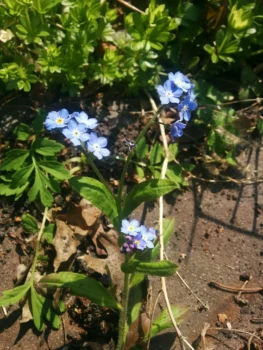
Woodland Forget-Me-Not: A Beautiful but Potentially Problematic Garden Guest
With its charming clusters of tiny blue flowers and heart-shaped leaves, woodland forget-me-not (Myosotis sylvatica) might seem like the perfect addition to your shade garden. But before you fall head-over-heels for this European beauty, there are some important things every responsible gardener should know.
What Is Woodland Forget-Me-Not?
Woodland forget-me-not is a perennial forb—basically a non-woody flowering plant—that originally hails from Europe. This delicate-looking plant produces masses of small, sky-blue flowers with bright yellow centers that bloom from spring through early summer. The flowers sit atop fuzzy stems with soft, oval-shaped leaves that form attractive ground-covering mats.
Where Does It Grow?
This adaptable plant has established itself across much of North America, thriving in both Canadian provinces and U.S. states. You’ll find it growing in Alberta, British Columbia, New Brunswick, Nova Scotia, Ontario, Quebec, Newfoundland, and Labrador. In the United States, it’s spread to California, Connecticut, Illinois, Maine, Massachusetts, Michigan, Minnesota, Nebraska, New Hampshire, New Jersey, New York, North Carolina, Ohio, Pennsylvania, Rhode Island, South Dakota, Vermont, Washington, Wisconsin, and Wyoming.
- Species observed
- No observations
The Invasive Reality Check
Here’s where things get complicated. While woodland forget-me-not is undeniably pretty, it’s classified as a non-native species that reproduces spontaneously in the wild. In Wisconsin, it’s actually listed as Restricted due to its invasive tendencies. This means it can escape cultivation and potentially crowd out native plants that wildlife depends on.
The plant’s aggressive self-seeding behavior, while creating lovely naturalized carpets, can spell trouble for local ecosystems. Once established, it’s quite persistent and can spread beyond where you originally planted it.
Growing Conditions and Care
If you’re in an area where woodland forget-me-not isn’t considered problematic, here’s what it needs to thrive:
- USDA hardiness zones 3-9
- Partial to full shade (though it can tolerate some morning sun)
- Moist, well-draining soil
- Cool, humid conditions
- Prefers upland areas rather than wetlands in most regions
The plant is remarkably easy to grow—perhaps too easy! It readily self-seeds and can quickly establish large colonies. While this makes it low-maintenance, it also means you’ll need to stay vigilant about managing its spread.
Garden Design Considerations
In appropriate settings, woodland forget-me-not works beautifully as:
- Ground cover in woodland gardens
- Underplanting for shrubs and trees
- Cottage garden borders
- Naturalized areas where spreading is desired
Wildlife and Pollinator Benefits
The small flowers do attract bees, butterflies, and other pollinators, particularly in early spring when few other flowers are available. However, native plants typically provide more comprehensive benefits to local wildlife, including specialized relationships with native insects.
Better Native Alternatives
Before planting woodland forget-me-not, consider these native alternatives that offer similar aesthetic appeal without the invasive concerns:
- Wild ginger (Asarum canadense) for ground cover
- Virginia bluebells (Mertensia virginica) for blue spring flowers
- Wild columbine (Aquilegia canadensis) for delicate woodland charm
- Foamflower (Tiarella cordifolia) for white spring blooms
The Bottom Line
While woodland forget-me-not is undeniably beautiful and easy to grow, responsible gardeners should think twice before planting it. Its invasive potential and ability to escape cultivation make it a risky choice, especially in areas where it’s already established in the wild.
If you’re determined to grow it, deadhead flowers before they set seed and monitor for unwanted spread. But honestly? You’ll probably be happier—and your local ecosystem will definitely be better off—if you choose one of the lovely native alternatives instead. Your garden can be just as gorgeous without contributing to invasive plant problems!