Yellow Star-Thistle: A Beautiful But Dangerous Invader You Should Never Plant
If you’ve ever driven through dry grasslands in the western United States during summer, you’ve likely seen fields blazing with bright yellow flowers that look almost magical from a distance. Meet yellow star-thistle (Centaurea solstitialis), a plant that’s as problematic as it is pretty. While this Mediterranean native might catch your eye with its sunny blooms, it’s definitely not something you want anywhere near your garden.
What Exactly Is Yellow Star-Thistle?
Yellow star-thistle is an annual forb—basically a non-woody herbaceous plant that completes its entire life cycle in one growing season. Originally from the Mediterranean region and southwestern Europe, this spiny customer has made itself far too comfortable across North America. It’s also known by the botanical name Centaurea solstitialis, and you might occasionally see it referred to by its scientific synonym Leucantha solstitialis.
Where You’ll Find This Unwelcome Guest
This invasive species has spread like wildfire across an enormous range, popping up in states from coast to coast including Alberta, Manitoba, Arizona, California, Ontario, Colorado, Connecticut, Saskatchewan, Florida, Idaho, Illinois, Indiana, Iowa, Kansas, Kentucky, Maryland, Massachusetts, Michigan, Minnesota, Missouri, Montana, Nebraska, Nevada, New Hampshire, New Jersey, New Mexico, New York, North Carolina, North Dakota, Ohio, Oklahoma, Oregon, Pennsylvania, Rhode Island, South Carolina, South Dakota, Tennessee, Texas, Utah, Virginia, Washington, West Virginia, Wisconsin, and Wyoming. That’s a lot of territory for one troublesome plant!
- Species observed
- No observations
Why Yellow Star-Thistle Is Garden Enemy #1
Here’s the thing about yellow star-thistle: it might look innocent enough with its cheerful yellow flower heads, but it’s actually an ecological nightmare. This plant is officially prohibited in Wisconsin and considered invasive across much of its range. Why all the fuss? Let me count the ways:
- It forms dense, impenetrable stands that crowd out native plants
- The spiny flower heads can injure people and animals
- It depletes soil moisture and nutrients, making it hard for other plants to survive
- It produces chemicals that inhibit the growth of nearby plants
- A single plant can produce thousands of seeds that spread easily
What It Looks Like (So You Can Avoid It)
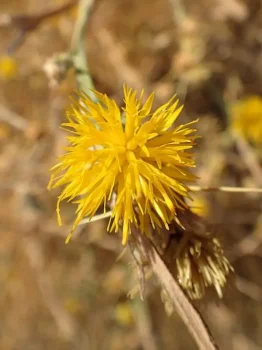
Yellow star-thistle grows as an annual forb, typically reaching 1-4 feet tall. The flowers are the dead giveaway—bright yellow composite flower heads surrounded by wickedly sharp spines that can be up to an inch long. The leaves are grayish-green and deeply lobed, and the whole plant has a somewhat woolly appearance. It blooms from late spring through fall, thriving in USDA hardiness zones 3-10.
Growing Conditions (That You Should Know to Combat It)
Understanding what yellow star-thistle loves can help you prevent it from taking over. This aggressive invader thrives in:
- Full sun locations
- Dry, disturbed soils
- Areas with poor soil fertility
- Overgrazed pastures and roadsides
- Recently burned areas
Better Alternatives for Your Garden
Instead of planting this invasive species (please don’t!), consider these beautiful native alternatives that will give you similar sunny yellow blooms without the ecological drama:
- Native sunflowers (Helianthus species)
- Black-eyed Susan (Rudbeckia species)
- Goldenrod (Solidago species)
- Native asters with yellow blooms
- Coreopsis species
What to Do If You Find It
If you discover yellow star-thistle on your property, don’t panic—but do act quickly. Contact your local extension office or invasive species coordinator for guidance on removal methods. Early detection and rapid response are key to preventing this plant from establishing a foothold.
The Bottom Line
While yellow star-thistle might have a certain wild beauty, it’s simply too destructive to native ecosystems to have any place in responsible gardening. This is one plant where the old saying look but don’t touch definitely applies—except in this case, it’s more like remove and replace with natives. Your local wildlife and plant communities will thank you for choosing better alternatives that support biodiversity rather than destroying it.
Remember, being a good gardener means being a good neighbor to the natural world around us. Sometimes that means passing up a pretty face when we know it’s trouble underneath!